THE GREAT STORMS
Every storm on this page is explorable in 3D in the observatory — the 2024 events as measured reconstructions, the historical ones as simulations, labeled as such in the app. This is the record they’re built on, pinned to the primary literature.
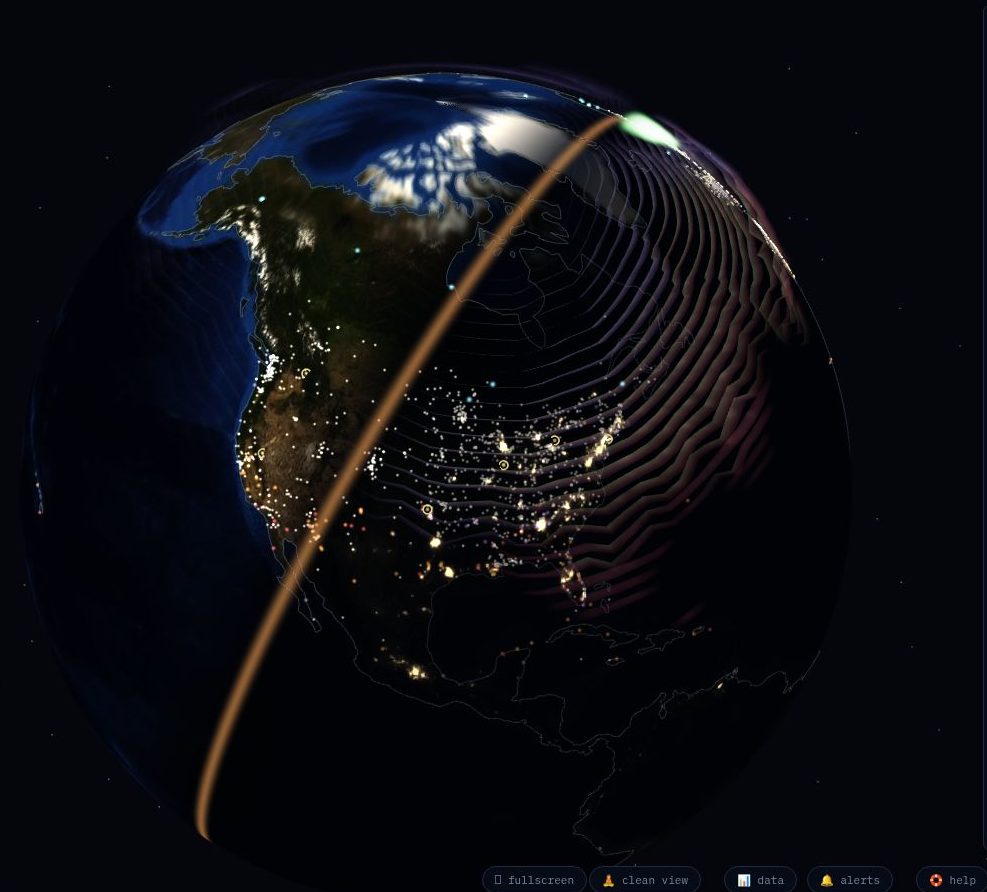
The storms that made history
Every one of these is explorable in 3D in the observatory:
- 1859 — the Carrington event. The benchmark superstorm: telegraph systems sparked and burned, aurora was reported from near-equatorial latitudes, and the CME crossed to Earth in about 17.6 hours1. Rendered as a historical simulation anchored to 33 timed eyewitness reports. Full story of the Carrington event →
"…two patches of intensely bright and white light broke out … the brilliancy was fully equal to that of direct sun-light … I saw I was an unprepared witness of a very different affair." R. C. Carrington, Monthly Notices of the Royal Astronomical Society, 18592 — the first solar flare ever recorded, timed to 11:18 GMT
- 1921 & 1989. The May 1921 storm burned out telegraph equipment3, with peak intensity re-estimated at −907 ± 132 nT4; March 1989 (−589 nT) collapsed Québec's power grid in 90 seconds and left it dark for nine hours5.
- 2003 — the Halloween storms. A parade of X-class flares — the biggest saturated the GOES sensors at X28, with ionospheric analysis putting it near X45 ± 56 — and back-to-back superstorms whose induced currents blacked out Malmö, Sweden7. Simulated here from the actual measured geomagnetic record. Full story of the Halloween storms →
- May 2024 — the Gannon storm. The strongest storm since 2003 (−412 nT)8, named for space physicist Jennifer Gannon, with naked-eye aurora reported from 24.3° magnetic latitude in the north (Hanle, India) and −23.2° in the south (Tivoli, Namibia)9. Reconstructed frame-by-frame from satellite measurements and validated against 486 star-calibrated photographs — this storm is why the observatory exists. Full story of the Gannon storm →
- October 2024. The follow-up G4, reconstructed through the same measured pipeline. Full story →
- Also reconstructed: the St Patrick's Day storm of March 2015 (G4, the strongest of solar cycle 24) and the November 2025 storm — both explorable in 3D with their own full write-ups.
advertisement
Frequently asked questions
- How long after an eruption does the storm reach Earth?
- Typically 1.5 to 3 days for an Earth-directed CME. Very fast ones can do it in under a day — the record is 14.6 hours (August 1972)10, and the 1859 Carrington CME took about 17.61. Coronal-hole streams aren't eruptions at all; they sweep past on a ~27-day rotation schedule.
- What's the strongest geomagnetic storm on record?
- The 1859 Carrington event is the benchmark — originally estimated at −1760 nT11, with modern reassessments near −90012. In the instrumented era: March 1989 (−589 nT)5, the 2003 Halloween sequence, and May 2024 (−412 nT)8 — the strongest in over two decades and the best-measured superstorm in history.
- Is the aurora dangerous?
- To a person on the ground, no — it happens 100+ km overhead. The storm behind it can be hazardous to infrastructure: geomagnetically induced currents stress power grids (Québec 1989), satellites suffer drag and charging, and GPS/HF radio degrade. That's why agencies forecast it. The full record — Québec's 92 seconds, the 2022 Starlink losses, GPS failing in the 2024 planting season — is its own chapter: when the sky reaches the ground.
Sources
Numbered references for the claims above, DOI-verified.
- Cliver, E. W. & Svalgaard, L. (2004). The 1859 solar–terrestrial disturbance and the current limits of extreme space weather activity. Solar Physics 224, 407–422. doi:10.1007/s11207-005-4980-z
- Carrington, R. C. (1859). Description of a singular appearance seen in the Sun on September 1, 1859. Mon. Not. R. Astron. Soc. 20, 13–15. doi:10.1093/mnras/20.1.13 (Hodgson's independent report follows on p. 15.)
- Hapgood, M. (2019). The great storm of May 1921: an exemplar of a dangerous space weather event. Space Weather 17, 950–975. doi:10.1029/2019SW002195
- Love, J. J., Hayakawa, H. & Cliver, E. W. (2019). Intensity and impact of the New York Railroad superstorm of May 1921. Space Weather 17, 1281–1292. doi:10.1029/2019SW002250
- Boteler, D. H. (2019). A 21st century view of the March 1989 magnetic storm. Space Weather 17, 1427–1441. doi:10.1029/2019SW002278
- Thomson, N. R., Rodger, C. J. & Dowden, R. L. (2004). Ionosphere gives size of greatest solar flare. Geophys. Res. Lett. 31, L06803. doi:10.1029/2003GL019345
- Pulkkinen, A., Lindahl, S., Viljanen, A. & Pirjola, R. (2005). Geomagnetic storm of 29–31 October 2003: geomagnetically induced currents and their relation to problems in the Swedish high-voltage power transmission system. Space Weather 3, S08C03. doi:10.1029/2004SW000123
- Hayakawa, H. et al. (2025). The solar and geomagnetic storms in 2024 May: a flash data report. Astrophys. J. 979, 49. doi:10.3847/1538-4357/ad9335
- Grandin, M. et al. (2024). The Gannon Storm: citizen science observations during the geomagnetic superstorm of 10 May 2024. Geoscience Communication 7, 297–316. doi:10.5194/gc-7-297-2024
- Knipp, D. J. et al. (2018). On the little-known consequences of the 4 August 1972 ultra-fast coronal mass ejecta. Space Weather 16, 1635–1643. doi:10.1029/2018SW002024
- Tsurutani, B. T., Gonzalez, W. D., Lakhina, G. S. & Alex, S. (2003). The extreme magnetic storm of 1–2 September 1859. J. Geophys. Res. 108, 1268. doi:10.1029/2002JA009504
- Cliver, E. W. & Dietrich, W. F. (2013). The 1859 space weather event revisited: limits of extreme activity. J. Space Weather Space Clim. 3, A31. doi:10.1051/swsc/2013053
📖 Improve this page — spotted an error, or want a topic covered?
By The Space Weather Observatory · checked against the data & methods record · Updated August 21, 2026
the sky · the sun · field guide · data & methods · about · privacy · pro · ☁️ seasonmap · ☕ support