HOW TO SEE THE AURORA
The practical chapter: darkness, timing, patience in substorm cycles, and what to expect from eyes versus cameras. For what the numbers mean (Kp, Bz, the G-scale table), see reading the numbers; for what the sky is doing right now, the live view renders NOAA’s feeds through the same validated pipeline as everything else here.
The short version
- Get dark, look north. City glow kills faint aurora before latitude does. Find an unobstructed northern horizon away from lights.
- Let your eyes adapt. 20–30 minutes without looking at a phone screen. One glance at full brightness resets you.
- Timing: the best displays cluster around local magnetic midnight — roughly 10 pm to 2 am — and statistics favor the weeks around the equinoxes, the Russell–McPherron effect1.
- Moonlight: a bright display punches through a full moon; a faint glow doesn't. Dark-of-moon nights are a real advantage on marginal events.
- Watch the data, not rumors: the live view runs on NOAA's real-time feeds, and free push alerts cover flares, storm levels, solar wind and proton events.
- Be patient in cycles. Substorms come in waves — how substorms work. Give a promising night at least one full cycle before quitting.
Camera versus naked eye
A phone's night mode stacks several seconds of exposure at high gain: it will show color and structure your eyes cannot see, every time. That's not a lie; it's a different instrument. Dark-adapted human vision runs on rods below roughly 1 kilorayleigh of green2,3 — you see a colorless gray veil first — and color arrives only as brightness climbs (green first; broad reds need a strong display). Deep red light sits at the edge of what rods detect at all.
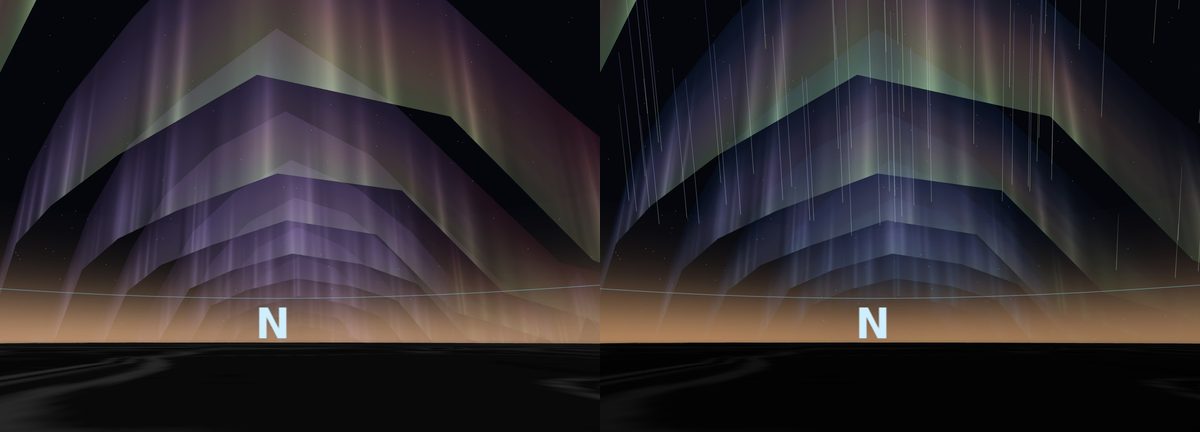
The observatory renders both: a long-exposure camera view calibrated against real photographs, and a naked-eye view built on the physiology of night vision, so you know what you'd have seen standing there — the answer to "why didn't it look like the pictures?"
Frequently asked questions
- What Kp do I need to see the aurora?
- It depends on your magnetic latitude, not your address. As a rough northern-hemisphere guide: Kp4–5 reaches the horizon from the northern-tier US, Scotland and Denmark; Kp7 brings it to the mid-latitude US and central Europe; Kp9 is continent-scale. Local darkness matters as much as Kp — and the live view shows where the visible border sits right now, which beats any rule of thumb.
- Can I see the aurora during a full moon?
- A strong display, yes — moonlight only washes out the faint glows. It hurts most on marginal nights and helps not at all otherwise; if the storm is real, go anyway.
- Will my phone camera see aurora my eyes can't?
- Yes. Night mode stacks seconds of exposure at high gain and will reveal color and structure invisible to dark-adapted eyes. If a faint glow is suspected, a 3–10 second exposure pointed north is the quickest confirmation there is.
Sources
Numbered references for the claims above, DOI-verified. Entries marked in the renderer are also implemented — their formulas or thresholds run as code in this observatory's engine (the data & methods page lists the full implementation set).
- Russell, C. T. & McPherron, R. L. (1973). Semiannual variation of geomagnetic activity. J. Geophys. Res. 78, 92–108. doi:10.1029/JA078i001p00092
- Hunten, D. M., Roach, F. E. & Chamberlain, J. W. (1956). A photometric unit for the airglow and aurora. J. Atmos. Terr. Phys. 8, 345–346. doi:10.1016/0021-9169(56)90111-8
- Chamberlain, J. W. (1961). Physics of the Aurora and Airglow. Academic Press. The International Brightness Coefficient scale: IBC I ≈ 1 kR at 557.7 nm.in the renderer
Aurora, by location: live forecast guides for Minnesota · Michigan · Washington · Maine · Alberta · Ontario · Scotland · Norway · Tasmania · New Zealand — and 30 more on the full location index.
By The Space Weather Observatory · checked against the data & methods record · Updated August 21, 2026
the sky · the sun · field guide · data & methods · about · privacy · pro · ☁️ seasonmap · ☕ support